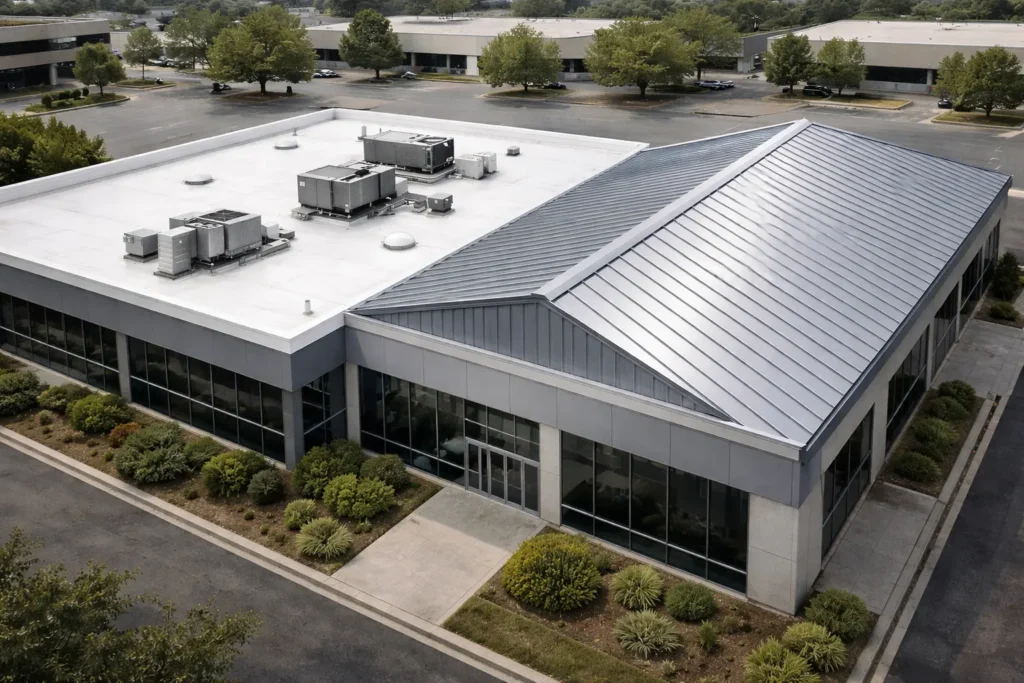
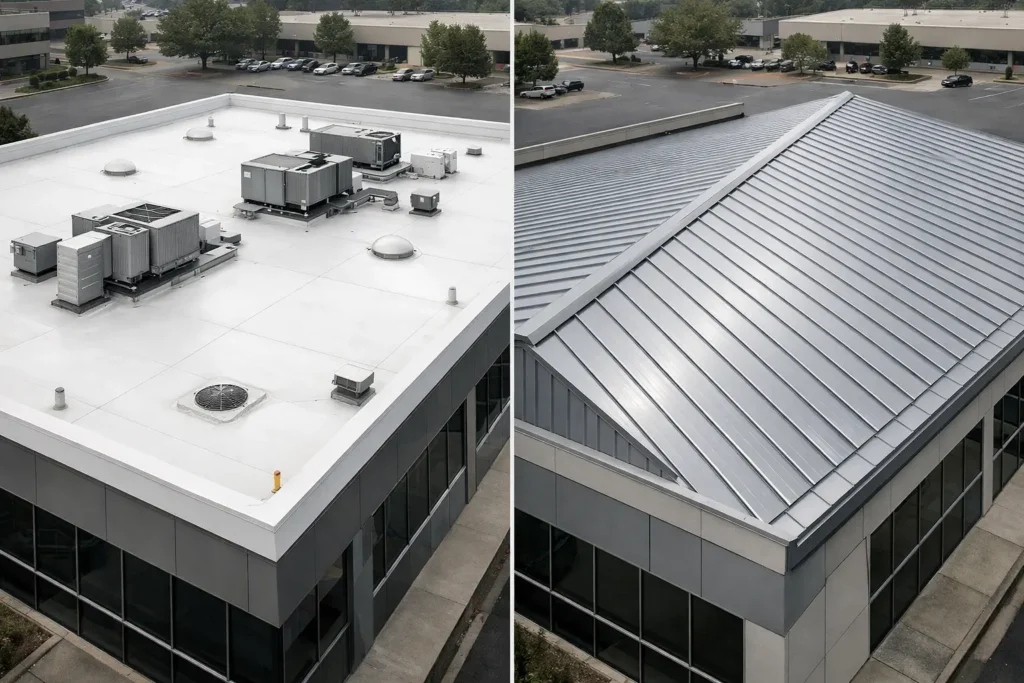
Choosing between a flat roof and a metal roof commercial system affects your property’s lifespan, energy bills, installation time, and long-term maintenance. Business owners now look beyond upfront costs. They’re analyzing lifecycle value, extreme weather performance, insurance implications, and building design compatibility.
Industry trend: More commercial buildings are switching to reflective metal roofs for energy efficiency and LEED points, while flat roofs remain popular for mechanical accessibility and low-budget builds.
In this guide, you’ll learn how both systems compare across materials, costs, energy performance, and legal requirements.
Why Are Flat Roofs Common in Commercial Buildings?
Flat roofing systems dominate urban commercial zones for practical reasons.
A commercial flat roof allows easier HVAC installation, solar panel mounting, and rooftop equipment access—especially in warehouses and retail buildings.
Key reasons for flat roof preference:
- Budget-Friendly Installation: Lower labor and material costs.
- Accessible Design: Ideal for equipment like AC units and vents.
- Space Efficiency: Horizontal area is usable for mechanical systems.
- Quick Setup: Faster timelines help avoid business disruption.
Common Flat Roofing Materials:
Material | Features | Common Use |
EPDM | Rubber membrane, flexible, UV-resistant | Warehouses, industrial buildings |
TPO | Heat-reflective, weldable seams | Energy-efficient office buildings |
BUR | Built-up layers of bitumen and fabric | Older retail and low-rise structures |
Flat roofs require proper drainage systems and insulation layers to prevent pooling, especially in climates with heavy rain.
What Makes Up a Commercial Metal Roofing System?
Metal roof commercial systems offer high durability, long lifespans, and strong weather resistance.
Metal roofs in commercial buildings consist of standing seam or R-panel systems using aluminum, Galvalume, or coated steel panels.
These roofs include:
- Fasteners and Clips: Secured via concealed or exposed methods.
- Substrate Options: Galvalume steel, aluminum, zinc alloys.
- Protective Coatings: To reduce corrosion and UV damage.
- Expansion Joints: Manage thermal cycling and structural movement.
Common Types of Metal Roof Commercial:
Type | Key Attributes | Best For |
Standing Seam | Hidden fasteners, watertight seams | Offices, hospitals |
R-Panel | Exposed fasteners, budget-friendly | Warehouses, garages |
Aluminum Roofing | Corrosion-resistant, lightweight | Coastal buildings |
Coated metal offers high UV reflectivity, fire resistance, and low maintenance needs, making it ideal for hot climates and storm-prone areas.
Flat vs. Metal Roof Commercial Materials—Which Lasts Longer?
Metal roofs outperform flat roofing membranes in durability and weather resistance.
Feature | Flat Roof (EPDM/TPO/BUR) | Metal Roof Commercial (Steel/Aluminum) |
Lifespan | 15–25 years | 40–70 years |
Durability | Prone to punctures | High impact resistance |
Maintenance | Frequent sealing | Minimal upkeep |
UV Resistance | Moderate (TPO better than EPDM) | Excellent with coatings |
Material Performance Comparison:
- Tensile Strength: Metal > PVC > TPO > EPDM
- Chemical Resistance: PVC & EPDM excel in industrial environments
- Weathering Index: Metal systems degrade more slowly over time
Flat membranes can fail at seams or under UV exposure, while metal panels expand and contract but rarely crack or puncture.
Installation Time & Business Disruption
Flat roofs are quicker to install, but metal roofs cause less disruption long-term.
Metric | Flat Roof | Metal Roof Commercial |
Average Install Time | 2–5 days | 5–10 days |
Labor Complexity | Low to moderate | High (skilled crew needed) |
Noise Impact | Low | Moderate |
Off-Hour Installation | Easier | Less flexible due to crew limits |
Metal roofs need:
- Deck preparation
- Precision sealing
- Staging areas for panels
Flat roofs require membrane welding, seam sealing, and drainage slope correction but allow for faster installation in occupied buildings.
Commercial Roofing Cost Comparison – Short vs Long-Term
Flat roofs cost less upfront, but metal roofs win in long-term ROI.
Cost Factor | Flat Roof | Metal Roof Commercial |
Initial Cost per sq ft | $5–$10 | $8–$15 |
Lifespan | 15–25 years | 40–70 years |
Energy Savings | Moderate | High |
Total Cost over 25 Years | Higher due to repairs | Lower due to longevity |
Example ROI Model:
- Metal Roof: Higher capital expense, but fewer repairs and lower energy costs = ROI in 10–15 years
- Flat Roof: Cheaper upfront, but needs more maintenance = higher lifecycle cost
Maintenance deltas and utility bills influence net present value (NPV). Always factor total cost of ownership over 25–30 years.
Flat Roof vs Metal Roof in Extreme Weather
Metal roofs offer superior protection in hail, wind, and snow.
Weather Condition | Flat Roof | Metal Roof |
Hail Impact | Prone to punctures | Resistant (Class 4 rated) |
Wind Resistance | Susceptible to uplift | Withstands high wind zones |
Snow Load | May pool water | Sheds snow efficiently |
Fire Resistance | Class B or C | Class A (non-combustible) |
Metal roofs also resist freeze-thaw cycles, thermal cycling, and wind uplift pressure better than membrane roofs.
For storm-prone regions, metal roofing systems offer clear resilience advantages.
Maintenance Demands – What Fails and How to Prevent It?
Flat roofs need more routine inspections; metal roofs need less but still require attention.
Common Issue | Flat Roof | Metal Roof Commercial |
Ponding Water | Frequent | Rare |
Seam Failure | Common | None (standing seam) |
Rust or Oxidation | No (non-metal) | Preventable with coatings |
Punctures | High risk | Low risk |
Preventative steps:
- Flat Roof: Check for punctures, sealant cracks, and pooling.
- Metal Roof: Inspect fasteners, coating integrity, and flashing.
Recommended: Biannual inspections, regardless of roof type.
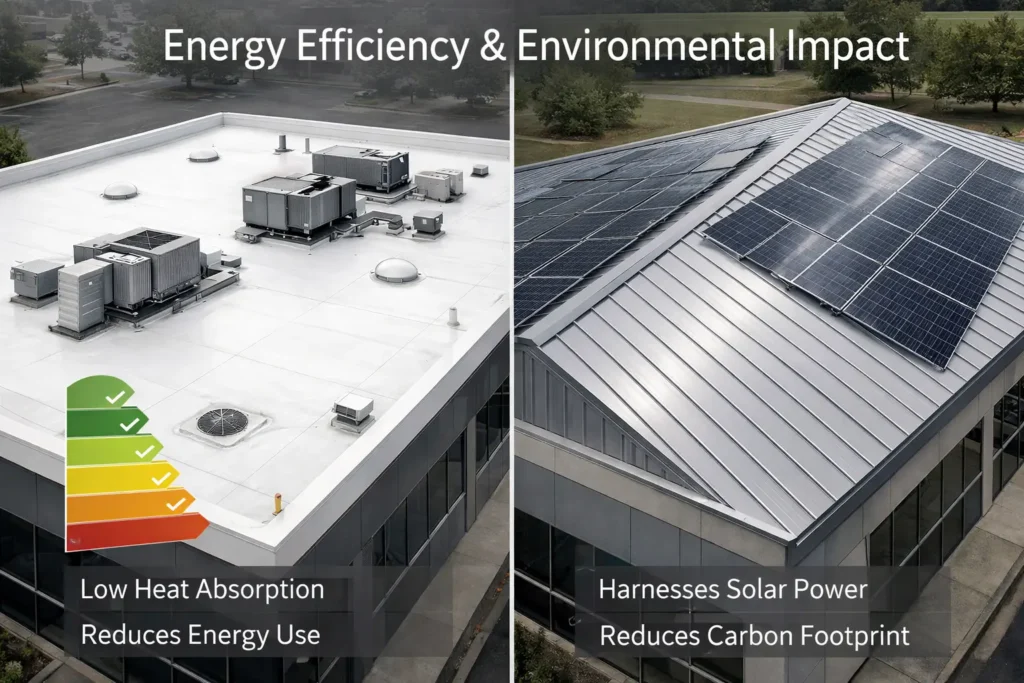
Energy Efficiency & Environmental Impact
Metal roofs outperform in solar reflectance, energy modeling, and recyclability.
Feature | Flat Roof | Metal Roof |
Solar Reflectance Index (SRI) | Moderate (TPO: high) | High (cool roof coatings) |
R-Value | Depends on insulation | Lower without insulation |
Solar Panel Compatibility | Easy to mount | Ideal with clamp systems |
Recyclability | Limited (EPDM = landfill) | 100% recyclable metals |
LEED Potential | Moderate | High |
Aluminum and coated steel panels support passive cooling, reduce heat island effect, and integrate well with solar energy systems.
Flat roofs allow solar arrays but may require ballasting, which adds load.
Insurance, Warranty & Legal Requirements
Metal roofs meet stricter fire codes and get better insurance ratings.
Factor | Flat Roof | Metal Roof |
Fire Rating | Class B or C | Class A |
Warranty Length | 10–20 years | 30–50 years |
Insurance Risk Profile | Higher for leaks | Lower for fire, impact |
Code Compliance | Easier but varies | More consistent with modern codes |
Most insurers prefer fire-rated roofs with longer lifespans—metal fits this better.
Always review roofing code for commercial buildings and check permit requirements.
Industry-Specific Recommendations: What Fits Best?
Choose a roofing type based on your building’s function, location, and tenant needs.
Building Type | Recommended Roof |
Warehouse | Flat (easy HVAC access) |
School | Metal (durability, safety) |
Healthcare Clinic | Metal (cleanability, fire safety) |
Shopping Center | Flat (HVAC, signage space) |
Office Complex | Metal (aesthetic, energy savings) |
Also consider:
- Load-bearing capacity
- Climate zone
- Energy use by tenants
- Building height and accessibility
Use roof system modeling tools for case-specific recommendations.
Final Verdict: Flat vs Metal Roof Commercial – Which Should You Choose?
Choose a flat roof for low upfront cost and easy equipment access. Choose a metal roof for long-term value and weather resilience.
Factor | Best Choice |
Budget Constraints | Flat Roof |
Long-Term ROI | Metal Roof |
Harsh Climate | Metal Roof |
Short-Term Lease or Renovation Plans | Flat Roof |
LEED or Energy Certifications | Metal Roof |
Use a decision matrix based on:
- Climate risk
- Building type
- Maintenance budget
- Lifespan goals
For most long-term owners, metal roofing systems deliver higher value per year and better property protection.
❓ FAQ: Flat Roof vs Metal Roof Commercial
What is the average lifespan of a metal roof commercial system?
40–70 years, depending on material (steel vs aluminum) and coating type.
Is a flat roof or metal roof better for a retail space?
Flat roofs are better for signage, HVAC, and cost-efficiency in retail builds.
How much does a metal roof commercial cost per square foot?
$8 to $15 per square foot, including materials and labor.
Can you install solar panels on a metal roof commercial building?
Yes. Standing seam metal roofs allow non-penetrating clamps for solar panels.
Which roof type is best for snowy climates?
Metal roofs. They shed snow efficiently and resist freeze-thaw damage.
Want More High-Quality Roofing Projects on Long Island?
G&V Roofing delivers trusted craftsmanship, reliable service, and local expertise that turns property owners into lifelong clients—all from one professional source.
Our Services:
Slate Roofing—Elegant, long-lasting, and perfect for upscale homes.
Tile Roofing—Durable and stylish roofing built to handle the Northeast climate.
Residential Roofing—From repairs to full replacements, we protect your home like it’s our own.
Commercial Roofing—Professional-grade roofing systems for businesses and facilities.
Gutters—Proper drainage solutions to protect your foundation and landscaping.
Windows—Energy-efficient and beautiful—enhance your view and lower utility bills.
Siding—Boost curb appeal and protect your exterior with high-performance materials.
Learn About:
Choosing the Right Roofing Materials for Long Island Homes
Roofing Tips for Nassau & Suffolk County Weather
How to Spot Roof Damage Before It Becomes Expensive
The Real Cost of Delaying Roof Repairs
Seasonal Roof Maintenance Checklists
🏡 Looking to Upgrade Your Roof or Protect Your Property Investment?
Whether you’re a homeowner looking for reliable roof solutions or a property manager seeking fast, expert repairs—G&V Roofing is your go-to Long Island partner for long-lasting protection and peace of mind.
Follow Us for the Latest in Roofing Care, Property Protection & Home Improvement:
Tiktok: Watch fast transformations, tips from the crew, and roofing secrets revealed
YouTube: Explore step-by-step guides, customer stories, and full project showcases
Instagram: See beautiful before-and-afters, behind-the-scenes content, and premium materials
Facebook: Read reviews, see featured jobs, and connect with the local G&V Roofing community
Contact G&V Roofing today and discover why craftsmanship matters